TCR Intelligence: Sector Brief - APAC Healthcare & Life Sciences · April 2026
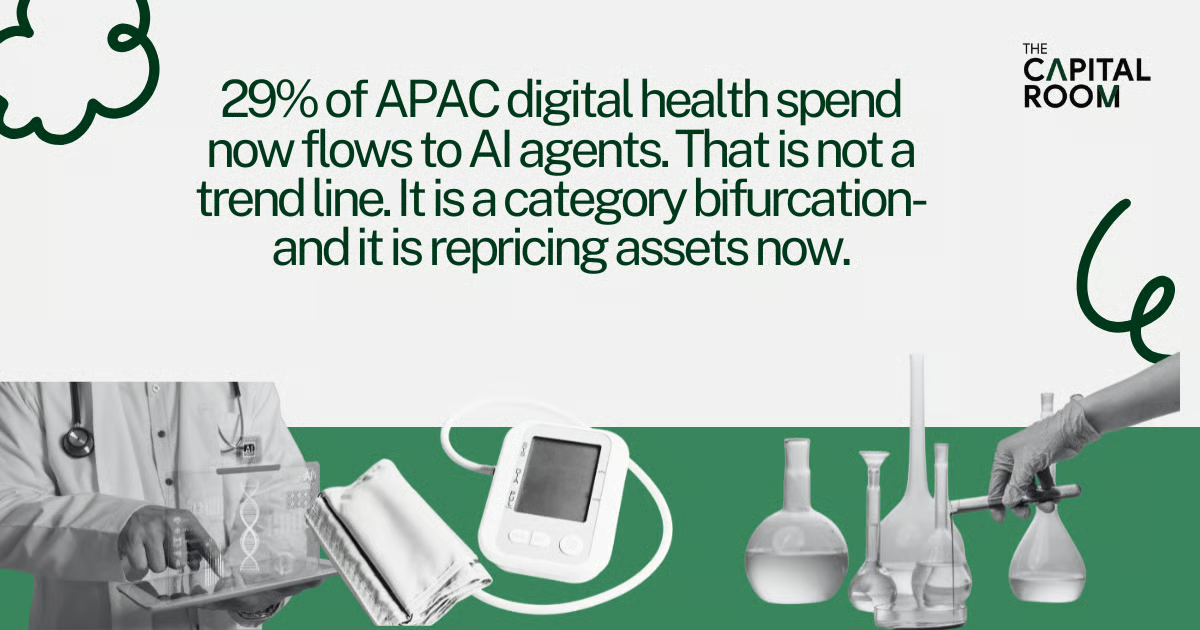
Agentic AI now commands 29% of regional digital health spend. Dual-track exits are the new default. The question sophisticated capital is asking in April 2026 is no longer what is growing- it is what is defensible, operational, and clinically validated.
FROM THE ROOM
What we are tracking across APAC healthcare private capital in April is not a sector story. It is a risk philosophy story that is playing out through healthcare assets.
The pattern: capital that spent 2023 and 2024 chasing growth multiples is now anchoring on defensibility. Not defensibility as a marketing term. Defensibility as a specific set of measurable characteristics- recurring cash flows, sticky patient populations, regulatory moats that a new entrant cannot replicate in a five-year window, and revenue lines that do not compress when a macro headline changes. Established generics platforms, hospital clusters in secondary cities, outpatient service networks -these are not exciting categories. That is precisely why capital is moving into them now.
The second pattern running underneath the first: the Agentic AI transition in digital health is no longer a thesis. It is a budget allocation reality. 29% of the region's digital health spend now flows to AI agents, up from 18% in 2025. This is not incremental. A reallocation of that scale inside a 12-month window changes which companies get funded, which get acquired, and which get stranded with a product architecture built for the previous cycle.
Both patterns converge on the same implication. The question a sophisticated fund is asking in April 2026 is not "what is growing." It is "what is defensible, what is operational, and what has an AI roadmap that a clinical buyer has already validated." The verticals below are the proof set.
PRIVATE EQUITY & M&A
The Mandate Signal
What capital is filtering for in April across APAC PE and M&A is straightforward to name: assets with resilient, recurring cash flows that are structurally insulated from regional geopolitical volatility. The specific sub-categories attracting the highest mandate concentration are established generics platforms with multi-market distribution, hospital clusters in secondary and tertiary cities across India, Southeast Asia, and Australia, and outpatient service networks with demonstrated utilisation rates above pre-pandemic baselines. The common thread is not growth. It is predictability of revenue under stress conditions. LP conversations we are tracking are explicitly framing this as a "safe harbor rotation"- a term that is now appearing in IC documentation, not just in positioning calls.
The Deal Pattern
Buy-and-build is the dominant transaction logic in post-acute care across Japan, Australia, and Singapore. The silver economy thesis has moved from LP pitch language to active deal structuring. Fragmented elderly care and rehabilitation markets are consolidating at pace, with sponsors running multi-asset acquisition programmes rather than single-asset bets. The driver is not demographics alone- it is the realisation that fragmented operators cannot achieve the data infrastructure or payer negotiation leverage that institutional capital can build across a consolidated network. Simultaneously, dual-track processes have become the default exit preparation posture for healthcare sponsors. With public market valuations remaining selective for anything below de-risked late stage, the simultaneous preparation of an IPO and a private trade sale is now a structural hedge rather than an exceptional circumstance.
The Structural Observation
The exit environment data makes the structural picture precise. Approximately 57% of recent healthcare exits in APAC have been strategic trade sales, with the IPO window opening selectively for late-stage, de-risked assets only. This has a direct implication for how deals are being priced and structured at entry: buyers are underwriting to trade sale multiples, not public market comparables. For sponsors entering assets now, the valuation discipline this creates is real. Assets that cannot demonstrate a credible strategic acquirer universe at entry are facing longer hold periods or compressed entry pricing. The dual-track process is not a sign of optionality. It is a sign that sponsors have internalised this constraint.
HEALTHTECH & DIGITAL HEALTH
The Mandate Signal
The mandate shift in digital health is specific enough to name precisely. Capital is no longer allocating to generative AI experimentation. What 75% of APAC providers now indicate they are prioritising- agentic AI- is a fundamentally different product category: autonomous agents capable of real-time clinical decision support and administrative workflow execution without human initiation at each step. The LP mandates we are tracking in this vertical are filtering for companies that have moved past the demo stage into clinical deployment, with measurable productivity outcomes that a hospital CFO can put in a board report. The budget shift- from 18% to 29% of regional digital health spend inside 12 months - tells funds that the window for backing the infrastructure layer of agentic AI in healthcare is open now, not in two years.
The Deal Pattern
What is moving at transaction level in digital health is chronic disease management infrastructure, specifically multimodal AI platforms with demonstrated clinical integration in developed APAC markets. South Korea and Singapore are the leading validation environments: both have the payer infrastructure, the patient data architecture, and the clinical buyer sophistication to generate the outcome data that justifies a Series B or growth round at institutional scale. What is stalling is single-modality AI tools with no pathway to clinical workflow integration- the category of company that built a compelling GenAI proof of concept but cannot answer the question of how it sits inside an existing EMR, payer, or care pathway. Funds with mandates in this vertical are filtering that category out at first screen.
The Structural Observation
The budget allocation data is the structural signal that changes context for the entire vertical. When AI agents command 29% of regional digital health spend in April 2026, the implication is not that digital health is healthy. The implication is that the category has bifurcated: a well-funded agentic AI tier, and everything else competing for a shrinking share of the remaining 71%. For a fund with a digital health mandate, the portfolio construction question is no longer about diversification across AI sub-categories. It is about concentration in the agentic layer before the valuation gap between the two tiers becomes permanent.
BIOTECH & LIFE SCIENCES
The Mandate Signal
The mandate shift is from followership to origination. Capital is pricing the difference between a company running someone else's molecule through APAC trials and a company that owns the IP, the data, and the regulatory pathway. The former is a service business. The latter is a platform. Funds that have not recalibrated their biotech screening criteria to reflect this distinction are filtering for the wrong companies.
The Deal Pattern
Private capital is moving into high-risk synthetic biology ventures at a pace that would have been unusual 24 months ago. The driver is the convergence of three things that did not previously coexist in APAC: original research capacity at the institutional level, regulatory infrastructure capable of processing complex biologics at speed, and a regional market large enough to justify indigenous drug discovery economics. Japan and Singapore's April streamlining of approval pathways for complex biologics is not a minor administrative change. It is a structural signal that these markets have decided to compete for Western pharma partnership on terms, not just on cost. For a fund evaluating a biotech asset in this environment, the due diligence question that now matters is not whether the company can run a trial. It is whether the company owns something a Western major cannot access elsewhere.
The Structural Observation
The $1.6 trillion APAC biotechnology market projection by 2034 at a 15% CAGR is the number LP conversations are anchoring on. What it changes structurally is the time horizon calculus for early-stage biotech entry. A market growing at 15% annually for a decade creates a compounding exit environment that changes how a fund underwrites a 7 to 10-year hold on a high-risk asset. The regulatory maturation in Japan and Singapore accelerates the timeline assumptions embedded in that underwriting. For a Western firm evaluating APAC biotech as a partner geography rather than a cost geography, the April regulatory moves are the signal that the transition is complete. For a fund sitting between that Western capital and APAC origination capacity, the coordination opportunity is now structural, not opportunistic.
REGIONAL INTELLIGENCE SNAPSHOT
THE COORDINATION LAYER
The cross-market pattern in April 2026 APAC healthcare is this: the "sovereign" play has become the governing logic across every vertical.
Investors are not just looking for defensible assets. They are prioritising companies that help APAC nations achieve health security on their own terms -- local vaccine manufacturing, domestic drug discovery, indigenous AI clinical infrastructure, in-country medical device supply chains. This is not ESG framing. It is a read on where government procurement, regulatory preference, and development finance institution capital are all pointing simultaneously. When DFI capital, sovereign wealth mandates, and private equity are all pointing at the same category, the risk-return calculus for a private fund changes.
The operational narrative requirement that sits underneath the sovereign play is equally specific. Value creation in 2026 is no longer being underwritten on growth assumptions alone. What LP ICs are requiring before they approve a healthcare investment is a cleaner data set, an explicit AI roadmap with clinical validation, and measurable outcomes that connect to a payer or government contract. The companies that have built this infrastructure are commanding a premium. The companies that have not are discovering that their growth rate is not sufficient to compensate for the narrative gap.
What we are watching is whether the IPO window that is beginning to crack open for late-stage, de-risked healthcare assets holds long enough to create a reference point for the broader market. If it does, the dual-track processes running in parallel right now will resolve toward the public route faster than current sponsor assumptions suggest. If it does not, the trade sale market -- currently absorbing 57% of exits -- will face a supply increase at exactly the moment strategic acquirers are recalibrating their own integration capacity.
The funds that are best positioned are the ones that have already decided which outcome they are underwriting for, and have structured the asset accordingly. That decision is happening now, not at exit.
The Room, Convened
Every month, TCR convenes an invite-only virtual roundtable bringing together verified investors, founders, operators, and corporates active in healthcare and life sciences. The conversations are off-record, the room is curated, and the intelligence that comes out of them informs the mandate and deal pattern observations you read in this issue.
If you are not yet on the calendar, subscribe for updates on upcoming roundtables at TCR Healthcare & Life Sciences Calendar
WORTH NOTING
Japan and Singapore streamlined complex biologics approval pathways in April. The shift positions both markets as preferred regulatory environments for Western pharma partnership, compressing the timeline assumptions that APAC biotech funds have historically built into their underwriting.
Agentic AI now commands 29% of APAC regional digital health spend, up from 18% in 2025. A reallocation of this scale inside 12 months is a category bifurcation signal, not a trend line; the valuation gap between agentic AI platforms and standard digital health assets is widening faster than deal pricing has yet reflected.
Strategic trade sales account for approximately 57% of recent APAC healthcare exits. Sponsors currently preparing dual-track processes are underwriting to trade sale multiples by default; funds entering healthcare assets now should verify that the strategic acquirer universe at entry is specific, not assumed.
TCR Intelligence is published weekly & monthly for a closed list of institutional stakeholders across India's private capital ecosystem. If this reached you through a forward and the intelligence is relevant to your position in the market, you can request direct access below.
To discuss a mandate, corridor programme, or platform access, write to: hello@thecapitalroom.co
The Capital Room is India's private capital intelligence ecosystem platform. We sit at the coordination layer between capital and opportunity across private markets.