TCR Intelligence: Sector Brief - APAC Fintech & Financial Services | April 2026
The pattern governing capital allocation in APAC fintech this April is not a sector trend. It is a structural reclassification of what the category means.
FROM THE ROOM
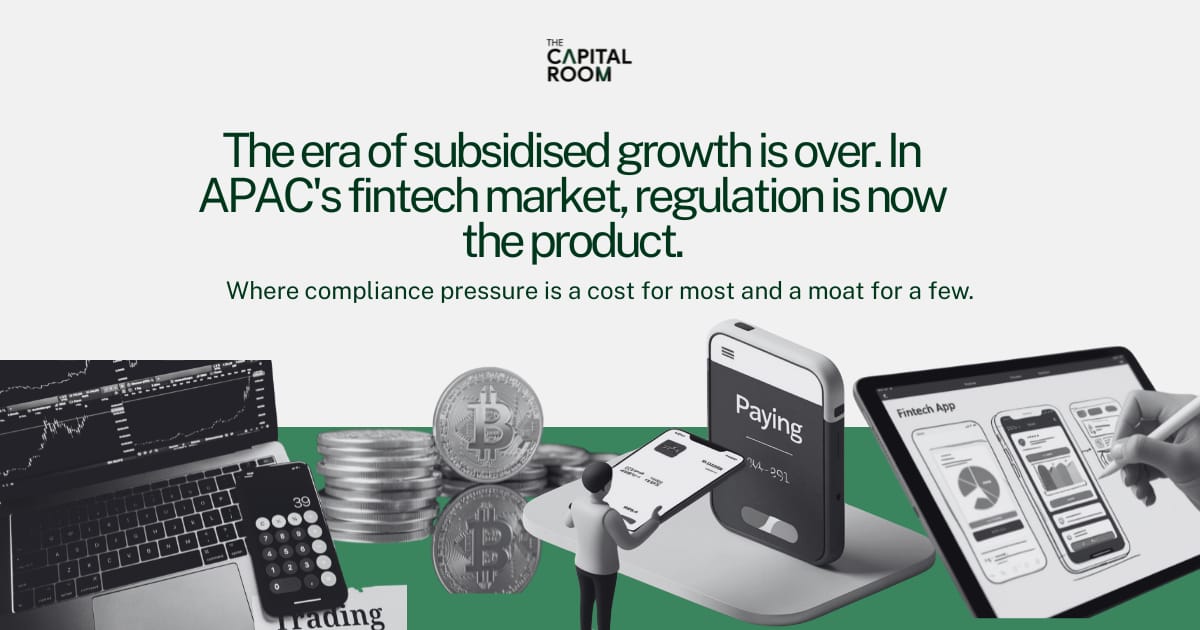
The pattern that holds across both verticals this April is structural, not cyclical. Capital in APAC's fintech and financial services market has stopped asking which firms are growing fastest. It is asking which firms become more defensible the harder the regulatory environment becomes. Those are different questions, and they produce different term sheets.
The fund mandates moving in April 2026 are written around one shared premise: the compliance burden that is raising costs for most players in this market is itself the product for a specific subset of them. Invisible authentication. Flow-based credit infrastructure. CBDC settlement bridges. Autonomous execution within regulatory boundaries. Each of these is a business whose addressable market expands in direct proportion to the pressure being applied to the market around it.
What the deal flow data shows across five APAC markets is that this is not a thesis. It is already a transaction pattern. The verticals below name where it is producing velocity, where it is producing stall, and what the structural observation is that the deal pattern has not yet fully priced.
Financial Services
The Mandate Signal
Fund mandates in APAC financial services are screening for one thing at IC level that most pitches in this vertical are not yet presenting: documented ROE improvement as a direct output of mid-office automation. Not projected improvement. Not improvement at scale. Demonstrated improvement at current operating volume, with the margin structure visible in the financials.
The specific functions that mandate criteria are focused on are KYC, AML, and credit underwriting. The mandate question is whether automation of these functions has structurally reduced the cost-to-serve, and whether that reduction holds when the next regulatory directive raises the compliance standard again. Funds that have built their thesis around platforms where the answer to that second question is yes are in a different deal conversation than funds still presenting AI adoption as a growth story.
Deployment mandates in this vertical are splitting along one clean line: B2B infrastructure capital is moving, D2C product capital is waiting. The waiting is not temporary. The LP allocation appetite that was funding D2C financial product businesses through the last cycle has recalibrated toward infrastructure where the revenue model does not depend on subsidised acquisition.
The Deal Pattern
The Account Aggregator ecosystem in India crossing 500 million linked accounts is evidence for a deal pattern that was already forming. What is moving at transaction level is not AA-adjacent businesses. It is the Credit-as-a-Service layer that the AA threshold has made viable at operating scale. SaaS platforms and e-commerce operators licensing embedded credit infrastructure rather than building lending stacks are closing. The distribution is pre-existing, the credit risk sits with the underlying lender, and the GP mandate fit is clean.
What is stalling is more instructive than what is moving. The secondary gold-fintech market in India has not slowed. It has closed. The New Income Tax Act's SGB tax treatment change has removed the structural incentive that made secondary gold products fundable. Funds carrying gold-adjacent fintech positions that have not yet reoriented their portfolio narrative toward tokenised real-world assets or digital silver are not in a slow market. They are in the wrong market.
On exit structure: M&A is not the primary route because IPO windows are narrow. It is the primary route because the strategic acquirer- traditional banks modernising legacy mid-office stacks -is an actively motivated buyer of enabler fintechs right now. The pipeline of motivated buyers is a deal pattern in its own right, and it is producing cleaner exit timelines than the IPO process for every company in this category that is not a super-app or a highly specialised infrastructure player.
The Structural Observation
The RBI's Two-Factor Authentication mandate effective April 1 is not a compliance event. It is a demand creation event for every platform that built invisible biometric authentication or hardware-bound security infrastructure before the mandate was written. The regulatory floor for digital transactions in India has been permanently raised. The cost of meeting that floor falls on every participant in the market. The companies that built the floor-meeting infrastructure in advance are now selling a necessity, not a feature. That shift in the nature of the product from- optional to required- is what the fund mandate is pricing, not the technology itself.
The mBridge project's progress on multi-CBDC interoperability across Hong Kong, Thailand, and the UAE deserves a separate read from the VC mandate tracking this sector. The capital forming around CBDC settlement bridge infrastructure is strategic and institutional in character, not venture in character. The return profile is infrastructure duration. The acquirer interest is from traditional banking institutions, not financial sponsors. A fund mandate benchmarked against venture return expectations will pass on this category consistently and correctly by its own criteria- but the category is real and the strategic capital forming around it is significant. The implication for fund positioning is which side of that line the mandate sits on, and whether that is a deliberate choice.
Fintech
To Read the Full Brief- Subscribe
THE COORDINATION LAYER
To Read the Full Brief- Subscribe
The Room, Convened
Every month, TCR convenes an invite-only virtual roundtable bringing together verified investors, founders, operators, and corporates active in fintech and financial services. The conversations are off-record, the room is curated, and the intelligence that comes out of them informs the mandate and deal pattern observations you read in this issue.
If you are not yet on the calendar, Subscribe for updates on upcoming roundtables at TCR Fintech & Financial Services Calendar
WORTH NOTING
Autonomous financial agent platforms are being priced as infrastructure, not software. The term sheets forming in Singapore and Sydney around AI execution platforms- not AI analysis platforms- are carrying infrastructure duration assumptions on valuation. The market has made the distinction. Fund mandates that have not made it are benchmarking the wrong comparables.
Indonesia's Agri-Fintech vertical has the most precise product-to-cash-flow match in APAC lending right now. The deal flow is early, the mandate fit is structurally sound, and there is no crowding. The window that is open in an uncrowded vertical with verified demand does not stay open at the same entry point.
The SGB secondary market cooling in India is not sector-wide. Gold-adjacent fintech is contracting. Tokenised real-world assets and digital silver are forming as the successor allocation thesis. The funds that read the SGB change as a sentiment shift rather than a structural one are tracking the wrong signal.
TCR Intelligence is published weekly & monthly for a closed list of institutional stakeholders across India's private capital ecosystem. If this reached you through a forward and the intelligence is relevant to your position in the market, you can request direct access below.
To discuss a mandate, corridor programme, or platform access, write to: hello@thecapitalroom.in
The Capital Room is India's private capital intelligence ecosystem platform. We sit at the coordination layer between capital and opportunity across private markets.